
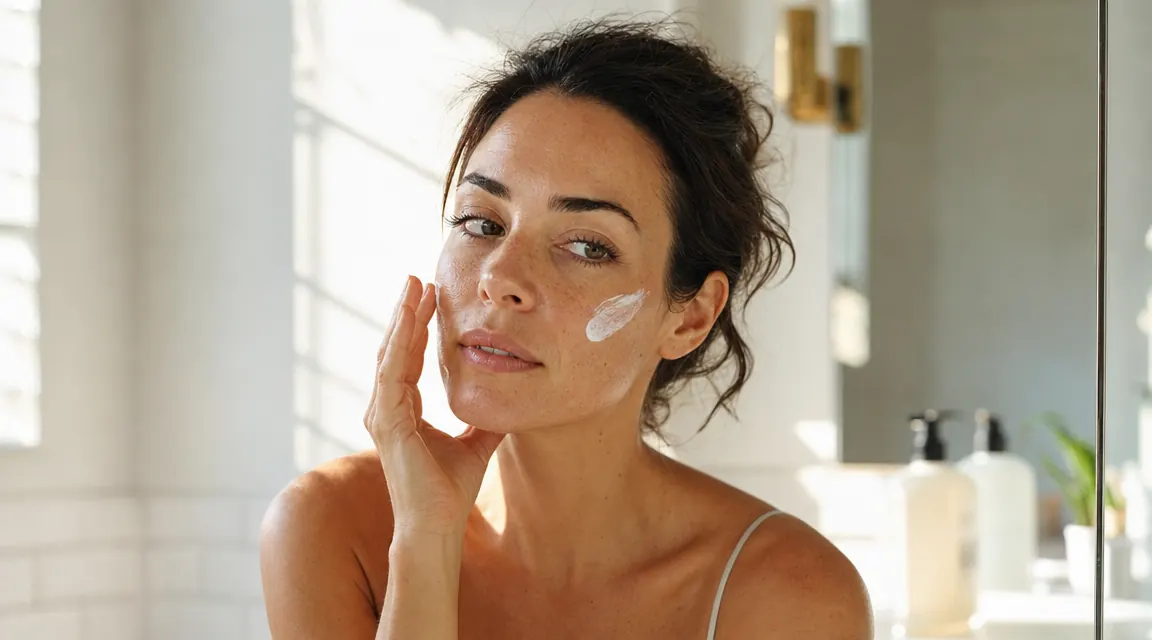
I spent six years behind an esthetics counter, and the number one complaint I heard about sunscreen was not the SPF number or the ingredients list. It was the finish. People would describe the same three problems over and over: white cast that made deeper skin tones look ashy, a pill-y mess that turned foundation into flakes, or an oil-slick shine that sent them reaching for setting powder every hour. Most of them had already tried two or three different sunscreens and concluded SPF just does not work on their skin. In almost every case, the formula was fine. The technique was the problem.
The good news is that every one of those problems is fixable without buying a new product. This guide walks through the exact application steps I taught clients, plus the one sunscreen I recommend when someone genuinely needs both a formula upgrade and a foolproof technique to go with it.
Tired of sunscreen that leaves a chalky ring or pills under foundation?
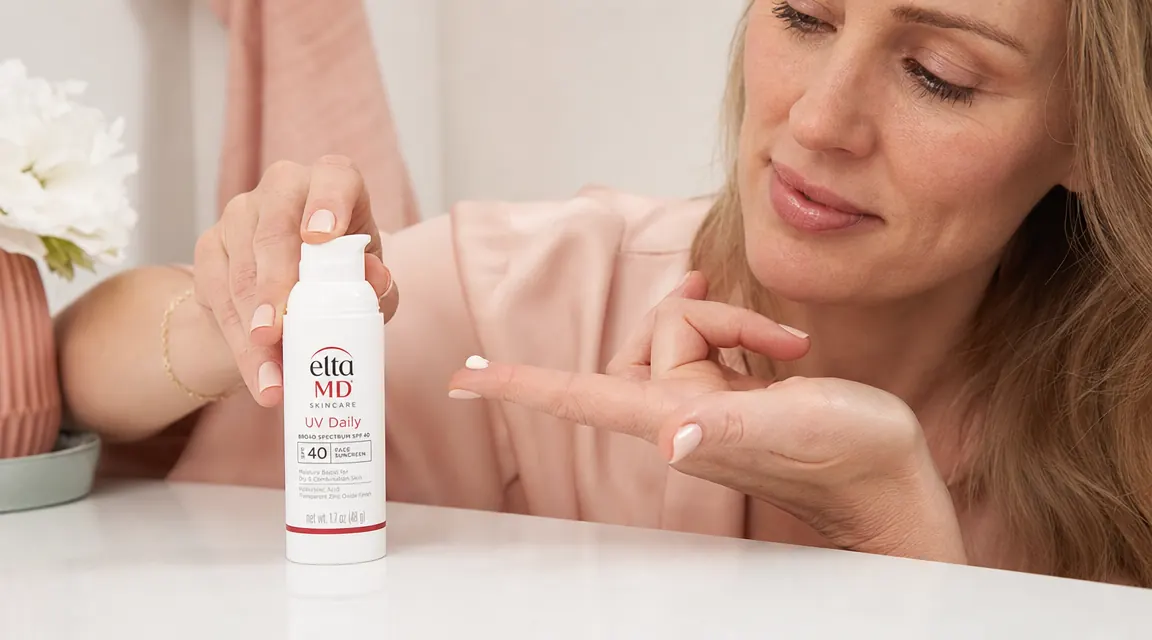
EltaMD UV Daily SPF 40 is the formula I recommend most often to clients who have given up on face sunscreen. It layers invisibly over moisturizer, wears for eight-plus hours without flashback, and never pills under makeup. Over 43,000 Amazon reviews back that up.
Amazon Check Today's Price on Amazon →Step 1: Start with a Fully Dry, Clean Face
This is the step most people skip or rush, and it is the single biggest cause of pilling. Sunscreen needs a dry surface to bond to. If you apply it over a moisturizer that is still slightly tacky, or over a serum that has not fully absorbed, the two products will not blend together. They will slide over each other, and when you try to work makeup on top, everything lifts and balls up.
The fix is simple: wait two full minutes after your last skincare step before reaching for SPF. Set a timer if you have to. Wash your face, apply serum, apply moisturizer if you use one, and then step away from the mirror. Make coffee. Get dressed. Come back with a genuinely dry face. Two minutes feels long in the morning, but it eliminates about 80 percent of the pilling complaints I have ever heard.
If you are in a rush and pilling is a persistent issue, consider skipping a separate moisturizer on mornings when you wear sunscreen. Many modern face sunscreens, including EltaMD UV Daily, contain enough hyaluronic acid and niacinamide that they function as a moisturizer-SPF hybrid for normal to dry skin. One product, one layer, no conflict.
Step 2: Use the Right Amount, in the Right Spot
The dermatology recommendation is a quarter teaspoon for the face alone. That is roughly the volume of a nickel pressed flat, or about one full pump from most SPF pump bottles. Most people apply about half that, which is why they are getting SPF 15 coverage from a product labeled SPF 40.
Dispense the product onto your fingertips, not directly onto your face. Dot it across the five points of your face: forehead, both cheeks, nose, and chin. This gets the product distributed before you start spreading, so you are not trying to move a glob from one spot across your whole face while dragging and pulling skin. Dragging a mineral sunscreen that has already started to set is another major cause of white cast, because you are working the zinc oxide into patches instead of spreading it uniformly.
Step 3: Pat, Do Not Rub
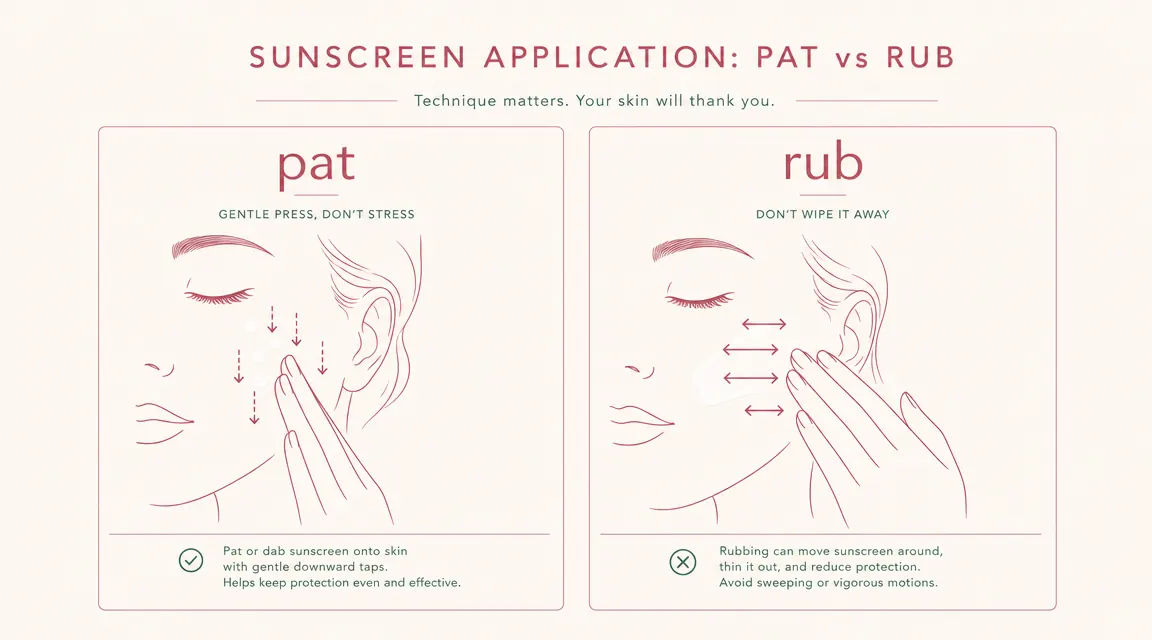
This is the technique shift that makes the biggest visible difference, especially for mineral sunscreens. Rubbing a zinc oxide formula across your face drags the white pigment into fine lines, around facial hair, and into the edges of your hairline where it turns chalky. Patting presses the product into the skin evenly without moving it sideways.
Use your ring finger and middle finger together, pressing in small overlapping pats from the center of your face outward. Take about thirty seconds per area and work all the way to your hairline, your jaw, and across your ears if you are spending time outdoors. Most people stop at the edges of their face and leave unprotected strips they do not notice until they are sitting in a car and the sun hits at an angle.
For chemical sunscreens, a light outward stroke works fine because there is no white pigment to move around. But even with chemical formulas, patting the final layer helps it sit on top of skin rather than getting pushed into pores, which can contribute to the thick, congested feeling some people associate with daily SPF wear.
Rubbing a zinc oxide formula across your face drags the white pigment into lines and patches. Patting it in presses the product evenly and lets it set cleanly before anything goes on top.

Step 4: Let It Set Before Touching Your Face or Applying Makeup
Sunscreen needs about sixty to ninety seconds to set after application before you apply anything on top. This is separate from the absorption time for your earlier skincare steps. If you go straight from SPF to foundation, you are applying makeup to a wet, slippery surface. The foundation grabs the sunscreen and the two blend together into something that is neither properly set nor properly adhered to your skin, which is what creates that midday separation effect where your makeup looks uneven in patches.
Stand in front of the mirror and let the sunscreen go from shiny to satin. With a formula like EltaMD UV Daily, that happens quickly because the base is light and the finish is intentionally semi-matte. With thicker mineral sunscreens, it may take two minutes. Either way, do not rush this step. Once makeup is on top of a fully-set SPF layer, it sits cleanly and lasts significantly longer.
Step 5: Choose the Right Primer or Foundation Pairing
Sunscreen pilling under makeup is almost always a compatibility problem between the SPF base and the primer or foundation going on top. Water-based sunscreens and silicone-based primers, for example, are notoriously bad partners. They sit on top of each other instead of blending, and movement during application creates balls of product. The rule of thumb: pair water-based SPF with water-based foundation, and oil-based SPF with oil-based foundation. When in doubt, check whether the primer or foundation you are using contains silicones as one of the first five ingredients. If your sunscreen is water-based and your primer is silicone-heavy, that is likely the culprit.
One of the reasons EltaMD UV Daily works well under makeup for so many people is that it has a light, water-based formula that is compatible with most foundation types. It does not contain silicones, so it does not fight with silicone primers or foundations the way some sunscreens do. If you have already solved the technique side of the equation and you are still getting pilling, switching to EltaMD UV Daily is often the last piece that resolves it.
Which Sunscreen Formula to Use for Each Concern
Not every formula suits every skin type or situation. Here is a quick breakdown based on the concerns I hear most often.
For fair to medium skin tones who want to skip color-correcting and still avoid white cast: a hybrid mineral-chemical formula is your best option. EltaMD UV Daily uses zinc oxide but at a concentration low enough that the finish is virtually invisible on skin with neutral or warm undertones. It sits sheer rather than opaque, so you get the stability benefits of zinc without the ghosting effect.
For deeper skin tones who have struggled with chalky mineral SPF: look for formulas where zinc oxide appears further down the ingredient list (indicating a lower concentration) or choose a tinted version that contains iron oxides to counteract the white cast. The application technique matters even more here. Patting rather than rubbing, and allowing full set time before anything touches the product, will reduce visible white cast significantly regardless of formula.
For oily or combination skin that dreads greasy SPF: the finish of the sunscreen matters more than the SPF number. A gel or fluid sunscreen with a matte or semi-matte finish will stay in place better than a cream formula that continues to slide. EltaMD UV Daily lands in semi-matte territory, which works for combination skin but may need a light dusting of setting powder at the T-zone for oilier skin types through a full day outdoors.
What Else Helps
A few extra steps that make a consistent difference for people who wear SPF daily.
Double cleansing at the end of the day removes sunscreen completely, which matters because mineral sunscreen in particular can build up on skin if you rely on a single-step cleanser. A gentle oil cleanser or micellar water as a first step breaks down the SPF, and a water-based cleanser as the second step removes everything that is left. If you are wearing SPF daily and noticing increased congestion or dullness, incomplete removal is often the reason. The CeraVe Hydrating Facial Cleanser works well as a second-step cleanser for this purpose on dry to normal skin, since it clears residue without stripping the barrier.
If you need to reapply during the day (which dermatologists recommend every two hours in direct sun), powder SPF or a setting spray with SPF over makeup is a practical way to top up without disturbing your base. These are not a perfect substitute for liquid SPF applied to bare skin in terms of coverage, but they are far better than skipping reapplication entirely.
Finally, store your sunscreen out of direct heat and sunlight. A bathroom cabinet or medicine cabinet is fine. A car glove box in summer is not. Heat degrades the active ingredients in both mineral and chemical sunscreens faster than normal, which is one reason people notice their SPF seems less effective after a summer of keeping it in a hot bag.
If you have tried every technique and you still get white cast or pilling, the formula itself is the variable left to fix.
EltaMD UV Daily SPF 40 is a hybrid zinc oxide formula with a light, semi-matte finish that works across skin tones and layers cleanly under foundation or tinted moisturizer. It is what I recommend to clients who have spent months frustrated with sunscreen and are ready to just have it work. Check the current price on Amazon to see if it fits your routine.
Amazon Check Today's Price on Amazon →