
When a product has 43,559 Amazon ratings and a 4.6-star average, you expect the reviews to tell the whole story. They do not. I spent years behind the esthetician counter listening to clients who had bought exactly the right product, used it the wrong way, or bought it for a skin type it was never designed for, and then blamed the product. EltaMD UV Daily SPF 40 is genuinely a very good face sunscreen. It is also misunderstood in ways that lead real people to either waste money or return it thinking it caused a breakout when it almost certainly did not. This review covers what the ratings skip.
I am not going to walk you through six months of daily wear here. That version of this review is already published. What I want to do is answer the specific questions that come up in one-star reviews and in the comment sections of every EltaMD post, questions about smell, about skin tone, about whether it breaks people out, about the moisturizer claim, and about whether the bottle math actually makes sense. If you are on the fence about spending real money on this, keep reading.
The Quick Verdict
EltaMD UV Daily earns its reputation for finish and wearability on light to medium skin tones. The breakout fear is mostly overblown, the moisturizer claim requires an asterisk, and the smell surprises almost everyone the first time. Know the limitations before you buy.
Amazon Check Today's Price →If your current SPF pills under foundation or leaves a white ring around your hairline, this is probably the fix.
EltaMD UV Daily SPF 40 is one of the most consistently recommended face sunscreens by dermatologists, with over 43,000 Amazon ratings. Check today's price and see whether it is in stock before your next order.
Amazon Check Today's Price on Amazon →The Smell Nobody Mentions
EltaMD UV Daily is marketed as fragrance-free. It is. But fragrance-free does not mean odorless, and almost no review mentions this. When you first pump it out, there is a faint clinical scent, something between zinc oxide and fresh pharmaceutical packaging. It is not unpleasant and it dissipates completely within about thirty seconds of application. But if you are used to unscented skincare that smells like absolutely nothing, the first morning with this product will surprise you.
This matters for a specific group of people: those with fragrance sensitivities who have been burned by products labeled fragrance-free that still caused reactions. The smell here comes from the zinc oxide and the inactive base ingredients, not from added fragrance compounds. In eight years of professional work, I never saw anyone have a sensitization reaction to the UV Daily formula. But the initial scent is real, and I wanted to name it rather than let you discover it on morning one.
Does EltaMD UV Daily Actually Cause Breakouts
This is the question I see most often in the one-star reviews. Someone with acne-prone or congestion-prone skin buys the bottle, uses it for two weeks, and notices new breakouts around their cheeks or chin. They leave a one-star review saying it clogged their pores. And then someone with the same skin type reads that review and avoids the product forever. Here is what is actually happening in most of those cases.
EltaMD UV Daily is labeled noncomedogenic, meaning it has been tested and found not to clog pores under standard conditions. The formula does not contain known pore-blockers like coconut oil, isopropyl myristate, or heavy silicones. So why do some people break out? Usually one of three things is happening. First, they are switching from a product that was suppressing their breakouts in some way, often a medicated or high-alcohol formula, and the new cleaner product is simply not providing that suppression. Second, they are over-applying to compensate for not feeling like the product is doing enough, and the excess is sitting in pores. Third, and most often, they were already breaking out before starting the product and the timeline looks like correlation.
I have used this on combination-acne-prone skin for extended periods and seen it used on dozens of treatment clients with similar profiles. The honest answer is that it rarely causes breakouts on its own, but it will not fix existing congestion either. If your skin is actively breaking out when you start using it, your skin will likely continue to break out. Give it six weeks before deciding whether this product is the cause.
EltaMD UV Daily is noncomedogenic and does not contain common pore-blockers. If you break out after switching to it, the product is almost certainly not the cause. The timing just looks suspicious.
The Skin Tone Problem Is Real, Just Not in the Way You Think
EltaMD UV Daily uses 9% zinc oxide as its primary active. Nine percent is on the lower end for a mineral SPF, which is why the formula blends more invisibly than most zinc-based products. On Fitzpatrick skin tones I and II, it is essentially invisible within thirty seconds. On Fitzpatrick III, you may notice a very slight brightening effect that actually looks like a natural luminosity rather than a cast. This is where the reviews are most glowing, and correctly so.
On Fitzpatrick IV, things get more nuanced. I have friends with medium-deep skin tones who use it successfully, but they use it under foundation only. Applied alone to deeper medium skin, UV Daily tends to create a slight ashy or graying effect where the light reflects differently than it would from their natural undertone. It is subtle, not the dramatic white cast you get from a 20% zinc formula, but it is there. On Fitzpatrick V and VI, this effect is more visible and the product is generally not the right choice unless it is being worn under makeup that corrects for it.
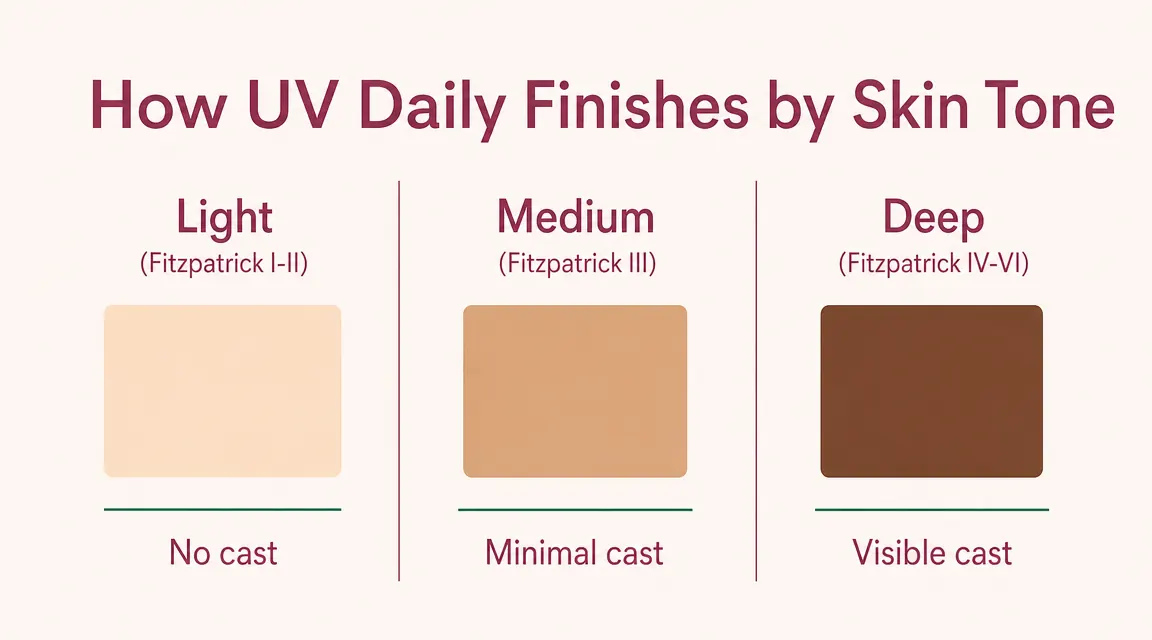
EltaMD does make alternatives that work better for deeper skin tones. The UV Elements Broad-Spectrum SPF 44 is available in a tinted version that neutralizes the cast and is often a better fit. If you have medium-deep to deep skin and you are set on EltaMD, that is the product I would point you toward instead of the UV Daily. The UV Daily reviews written by people with deeper skin who love it are almost universally written by people who wear foundation on top of it every day.
The Moisturizer Claim: What It Actually Means
EltaMD markets UV Daily as a moisturizer with SPF, not just a sunscreen. This framing is responsible for a lot of disappointment in the reviews. People with dry or very dry skin buy it expecting it to replace their moisturizer entirely, apply it, feel comfortable at 8 a.m., and then feel tight and uncomfortable by 11. This is not a product failure. It is a marketing claim that needs context.
The moisturizing ingredients in UV Daily are hyaluronic acid and a small amount of tocopheryl acetate (vitamin E). Hyaluronic acid is a humectant, meaning it draws moisture from the environment to the surface of your skin. In a climate with reasonable ambient humidity, that works well. In a dry office, an airplane, or a cold-weather environment indoors, a humectant without an occlusive layer on top of it can actually leave skin feeling more parched than before application, because it pulls moisture up and then that moisture evaporates.
For normal to combination skin in a temperate or humid climate, UV Daily genuinely holds its own as a standalone morning product. For dry skin in any season, or for any skin type in very low humidity environments, you need something with an occlusive element underneath it first. A thin layer of a ceramide moisturizer, a few drops of a squalane-based oil, or even a well-formulated serum before UV Daily will give you the experience people with combination skin are raving about. Without that prep layer, dry skin will fight this product by lunch.
The Under-Application Problem That Makes SPF Worthless
This is the dirty secret of all face sunscreen reviews, and it applies here too. SPF ratings are tested at a specific application amount: 2 milligrams per square centimeter of skin. For the average adult face and neck, that translates to approximately two full finger-lengths of product, or roughly a quarter teaspoon. Most people apply a fraction of that amount, often because they are scared of how much it is, or because they assume more product means more shine or pilling.
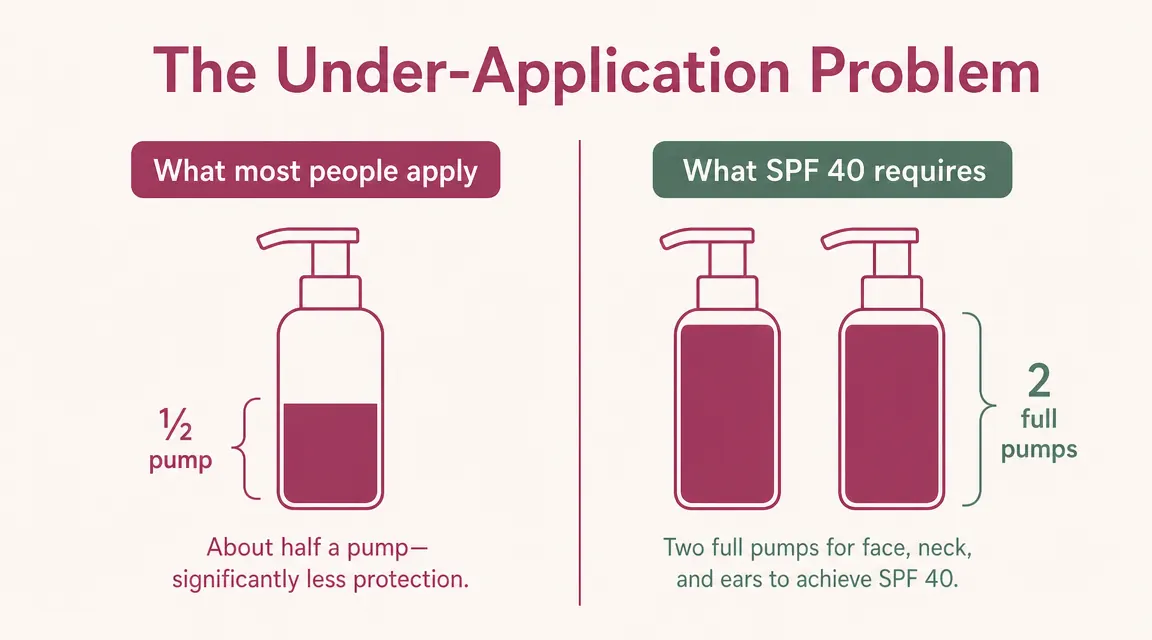
If you are applying half the recommended amount of an SPF 40, you are not getting SPF 20. The math is not linear. Under-application produces unpredictable and dramatically lower protection, potentially as low as SPF 3 to 8. This is not an EltaMD problem. It is an industry-wide issue that no brand talks about directly because it makes the conversation uncomfortable. But if you are reading a review where someone says UV Daily did not protect them from a sunburn, the most likely explanation is they applied a thin smear rather than a proper dose.
The practical implication for UV Daily specifically is this: at the correct application amount, it does not feel heavy on normal to combination skin. The formula absorbs cleanly even at full dose. You are not choosing between adequate protection and a comfortable wear experience. You can have both, but only if you apply the full amount. I measure out the right quantity every morning. It becomes automatic within a week.
How It Wears on Textured Skin Versus Smooth Skin
Every promotional image for EltaMD UV Daily shows it on impossibly smooth, pore-free skin. That is true of every sunscreen, and it is not useful information. Here is what I have actually observed on skin with visible texture, enlarged pores, or mild rosacea.
On skin with enlarged pores across the nose and cheeks, UV Daily sits in pores slightly rather than filling them. It does not make pores look larger, but it does not reduce their appearance the way a silicone-heavy formula might. The finish is satin rather than blurring. If you are used to a pore-blurring SPF with heavy dimethicone, UV Daily will feel less polished in those areas.
On skin with rosacea, UV Daily is one of the most consistently comfortable options available. The fragrance-free, minimal-irritant formula rarely triggers flushing or sensitivity. The zinc component also helps diffuse surface redness modestly, which is a meaningful benefit for anyone managing visible redness without wanting to wear full coverage every day. Rosacea skin is one of the strongest use cases for this product, and it is underrepresented in the reviews.
On skin with active flakiness from dryness or from retinol use, UV Daily will cling to dry patches and make them look more visible, not less. If you are going through a retinol adjustment period and dealing with flaking on your forehead or cheeks, apply a few drops of a hydrating oil over the flaky areas before UV Daily, and buff gently. Applying sunscreen over unaddressed dry patches never looks good regardless of formula.
The Bottle Math: Is the Price Actually What It Looks Like
At today's price on Amazon, one 1.7-ounce bottle of EltaMD UV Daily is a real skincare purchase. The question most reviews do not address is how long the bottle actually lasts at proper application amounts. If you apply the full recommended dose every morning to your face and neck, one 1.7-ounce bottle lasts approximately seven to eight weeks for most people. That works out to roughly five to six cents per day less than a cup of coffee, more than a drugstore SPF.
But here is the comparison that is actually relevant. If UV Daily is genuinely replacing both your moisturizer and your sunscreen, you are consolidating two products into one. A decent daily moisturizer plus a separate SPF adds up faster than you might expect, especially if you gravitate toward anything beyond the cheapest drugstore options. At that math, UV Daily is not dramatically more expensive than a two-product morning routine. It is just one expense instead of two, which also means less time and less layering.
The value story does break down if UV Daily does not work as a standalone moisturizer for you, which as I covered above is a real possibility for dry skin. If you need to layer something underneath it, you are back to two products and the value comparison shifts. Know your skin type before running the math.
What I Liked
- Essentially invisible on Fitzpatrick I-III skin tones with no white cast
- One of the safest face sunscreen choices for rosacea and reactive skin
- Noncomedogenic with minimal pore-clogging ingredients, rarely the true cause of breakouts
- The initial scent dissipates in under a minute and leaves no fragrance residue
- Absorbs cleanly even at the correct full-dose application amount
- Genuinely replaces moisturizer for normal to combination skin in temperate climates
- Over 43,000 Amazon ratings reflect a product with real, broad consistency
Where It Falls Short
- Creates a visible gray or ashy tone on Fitzpatrick IV-VI without foundation on top
- Humectant-based moisturizing is not enough for dry or very dry skin without an occlusive layer underneath
- The initial medicinal zinc scent surprises people who expect fragrance-free to mean odorless
- Pore-blurring finish is modest compared to silicone-heavy formulas, visible pores stay visible
- Current price per ounce is high compared to drugstore options that perform adequately
- Clings to flaky patches during retinol adjustment phases, requires pre-treatment of dry spots
Who This Is For
EltaMD UV Daily is the right buy if you have normal, combination, or oily skin and you fall in the Fitzpatrick I through III range. It is especially worth it if you have rosacea or reactive skin that struggles with fragrance or irritants in most SPFs. It is also a strong call for anyone who wants a legitimate one-step morning routine without sacrificing finish quality, as long as your skin does not have high hydration needs. People who build disciplined skincare habits tend to stick with this one because it never fights back in the morning.
Who Should Skip It
Skip EltaMD UV Daily if you have dry or very dry skin and you are hoping one product handles all your morning hydration. It will not. Skip it if you have Fitzpatrick IV or deeper skin and you plan to wear it without foundation on top, the zinc formula was not designed for your tone and you will see it. Skip it if you prefer pure mineral protection without any chemical UV filters. Octinoxate, while considered safe by most regulatory bodies, is a chemical active, and for those committed to mineral-only SPF this formula is a hybrid. And skip it if the price feels hard to justify right now. There are capable drugstore face sunscreens. They will require more trial and error to find a formula that feels as elegant, but they exist.
If the skin tone question is your main hesitation, my full comparison between EltaMD UV Daily and La Roche-Posay Anthelios covers how the two formulas perform differently across Fitzpatrick types, it is worth reading before you decide. And if you are still working out whether daily SPF is worth a consistent habit at all, the case for why daily face sunscreen matters more than any serum you are using will put the decision in context.
If your current SPF feels like a compromise every single morning, this is the one most people actually stop dreading.
EltaMD UV Daily SPF 40 has earned 4.6 stars across more than 43,000 Amazon reviews. Check today's price to see current availability and decide if it fits your routine and budget.
Amazon Check Today's Price on Amazon →